




Short answer: Yes. AI is already reducing medical claim denials where it’s implemented well- 69% of providers using AI for denials report measurable improvement, and mature deployments are seeing 30–40% denial rate reductions within months.
Primary keyword: AI reduce denial claims
Secondary keywords: medical billing AI Arizona, denial management AI, claim denial reduction, RCM automation, clean claim rate, Arizona medical billing company
Quick Takeaways
- AI reduce denial claims- core focus; AI can cut denials 10-40%+ depending on maturity.
- Medical billing AI Arizona- local relevance for Phoenix, Tucson, Mesa, and statewide practices.
- Denial management AI- predictive scoring, real-time eligibility, NLP coding checks.
- Claim denial reduction- target preventable denials (up to 75% are administrative).
- Clean claim rate- best-in-class <5%; AI helps push more claims clean on first pass.
- RCM automation- end-to-end revenue cycle tools with human oversight.
Why Are Claim Denials Rising in 2026?
Denial rates have climbed steadily, creating revenue leakage that manual teams can’t keep up with.
- Initial claim denial rates hit 11.8% in 2024 and hovered around 12% in 2025–2026.
- 41% of providers now report denial rates of 10% or higher, up from 30% in 2022.
- Up to 65% of denied claims are never reworked, turning into permanent write-offs.
- Three in four denials (75%) stem from paperwork, authorization, or patient data issues, not clinical judgment meaning most are preventable.
For Arizona practices dealing with AHCCCS, BCBS-AZ, and Medicare Advantage workflows, the mix of eligibility errors, prior auth failures, and coding mismatches is a major driver.
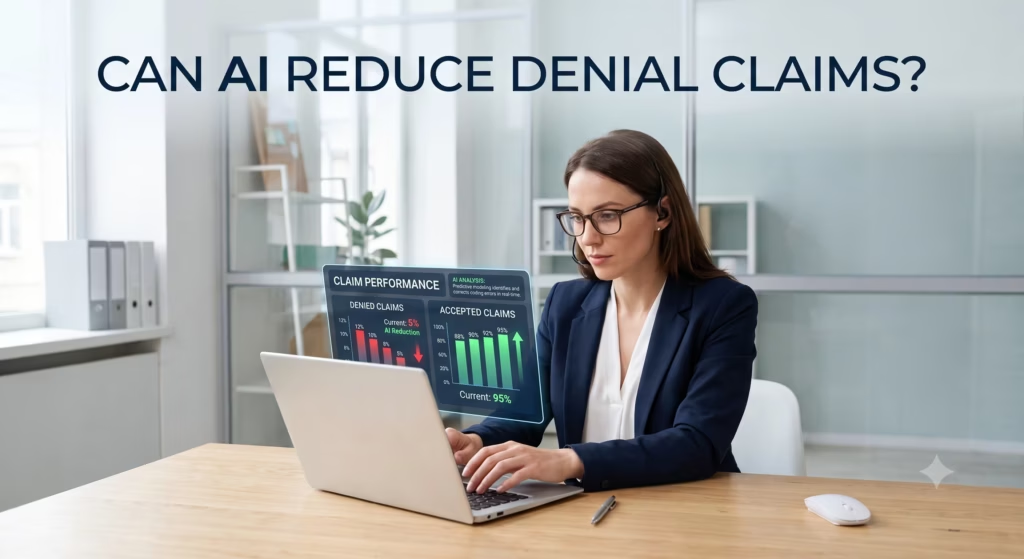
Can AI Reduce Denial Claims? What the Data Says
Yes, and the effect is measurable when AI is applied upstream (before submission) rather than just chasing denials after the fact.
- 83% of organizations reported at least a 10% denial reduction within six months of deploying AI-driven automation; mature implementations reach 30–40% reductions.
- Practices using staff + AI collaboration models saw an 18% mean reduction in denial rates versus legacy rule-based tools.
- Among providers already using AI for denials, 69% say it boosted claims success (fewer denials or better resubmission outcomes).
Bottom line: AI doesn’t magically fix everything, but it systematically prevents the most common, preventable errors that cause denials.
How Does AI Reduce Denial Claims? (The 3 Upstream Levers)
AI works best when it moves error detection earlier in the revenue cycle.
1) Predictive Denial Scoring
Machine learning models score every claim for denial risk before submission, flagging high-risk claims for review.
2) Real-Time Eligibility & Authorization Checks
AI verifies coverage, benefits, and prior auth requirements before the visit, catching mismatches that would otherwise trigger denials.
3) NLP-Based Coding Validation
Natural language processing reads clinical notes and validates CPT/ICD codes against documentation, reducing under/over-coding and modifier errors.
These levers directly target the top denial causes: missing/inaccurate data, authorization failures, and incomplete patient information.
What Do Real Users Say About AI Billing Tools?
Reviews highlight recurring themes that matter when choosing an AI-enabled billing partner or platform.
- Customer support gaps: Users report slow responses and cases closed without real fixes.
- Incomplete coding workflows: Some tools don’t fully cover specialty-specific coding nuances, requiring human override.
- Interface clutter & transparency: Dashboards can feel overwhelming; audit trails and explainability matter for compliance.
Translation for Arizona providers: AI is powerful, but you still need a human-led process, clear escalation paths, and transparent reporting especially for AHCCCS and Medicare Advantage quirks.
Arizona practices face unique payer mixes and state Medicaid (AHCCCS) rules. A smart local strategy ties AI denial prevention to Arizona workflows.
- AHCCCS compliance: Eligibility, prior auth, and claim edits differ from commercial payers; AI rules must be tuned to AHCCCS policies.
- Phoenix/Tucson/Mesa coverage: Local teams understand regional payer behaviors and can align AI alerts with real-world follow-up cadences.
- Clean claim benchmarks: Best-in-class first-pass denial rates are under 5%; many Arizona practices sit at 8–12% without AI-assisted scrubbing.
Risks, Contraindications, and Compliance Guardrails
AI is not a plug-and-play cure. There are real risks if governance is weak.
When AI May Not Be Appropriate
– No human oversight: If your team won’t review AI-suggested codes or high-risk claims, audit risk rises.
– Consumer-grade AI tools: General LLMs without HIPAA controls should not touch PHI.
– Unclear vendor controls: Missing BAA, weak encryption, or no SOC 2 Type II certification are red flags.
Key Compliance Risks to Manage
– Upcoding by algorithm: AI suggesting higher E/M levels without documentation support = your liability.
– HIPAA attack surface expansion: Prompt injection, data poisoning, and third-party data exposure require specific controls.
– Black-box decisions: If you can’t audit why a claim was coded a certain way, you risk OIG scrutiny.
Best practices:
– Require signed BAA, end-to-end PHI encryption, role-based access, and immutable audit logs.
– Keep human-in-the-loop review for AI-suggested codes and high-value claims.
– Run AI-specific risk assessments and vendor due diligence (NIST AI RMF alignment).
AI vs. Human-Led Denial Management: What Works Best?
| Approach | Strengths | Weaknesses | Best For |
| Manual-only | Deep clinical judgment; flexible appeals | Slow; misses upstream errors; high rework | Very small practices with simple payer mix |
| Rule-based automation | Consistent edits; fast clearinghouse checks | Brittle; can’t adapt to new payer policies | Practices with stable, low-complexity claims |
| AI + human oversight | Predictive scoring; NLP coding checks; scales with volume | Requires governance; vendor diligence; training | Multi-specialty, AHCCCS + commercial mix, high denial rates |
Data shows AI + staff collaboration outperforms legacy automation, with an 18% mean denial reduction and faster collections.
FAQs:
Can AI reduce denial claims for small Arizona practices?
Yes. Small practices with 8- 12% denial rates can often reach sub-5% first-pass denials by adding AI-driven eligibility checks, claim scrubbing, and predictive scoring especially for AHCCCS and Medicare Advantage claims.
How quickly will AI reduce denial claims?
Many organizations see at least 10% reduction within six months; mature setups reach 30- 40% as rules tune to their payer mix.
Is AI medical billing HIPAA compliant?
It can be, but only with the right controls: signed BAA, SOC 2 Type II, end-to-end encryption, role-based access, and audit logs. Consumer AI tools are not compliant out of the box.
What denial types does AI prevent best?
Administrative denials: eligibility mismatches, prior auth failures, missing demographics, and coding/documentation mismatches about 75% of denials.
Do I still need human billers if I use AI?
Yes. AI should augment, not replace, human judgment especially for complex appeals, specialty coding, and compliance oversight.
How do I choose an AI-enabled billing partner in Arizona?
Look for: AHCCCS experience, transparent reporting, clear escalation paths, compliance certifications (SOC 2, BAA), and proven denial reduction metrics.
Ready to Reduce Denials with AI in Arizona?
If you’re in Phoenix, Tucson, Mesa, or anywhere in Arizona and tired of chasing denials, book a call with PMBC LLC to help you implement AI-assisted denial prevention with human-led oversight tailored to your payer mix and specialty.