






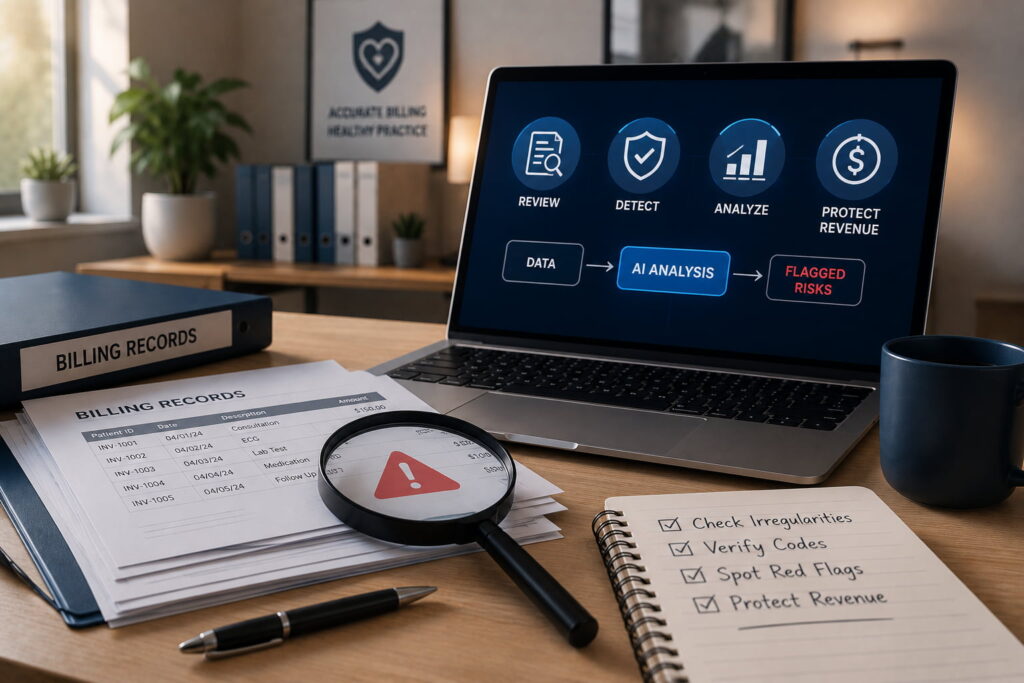
Fraud in billing records is often hidden inside routine claims, coding patterns, and documentation gaps, which means practice owners, nurse practitioners, and small clinics in Arizona need a system, not guesswork, to catch it early.
What should you watch for first?
The fastest way to spot fraud is to compare every bill against supporting documents: the encounter note, orders, EOB, modifier usage, and date of service. Common red flags include services that were never provided, duplicate charges, unbundled procedures, unusually high use of high-value codes, and claims that keep getting denied for the same reason. In Arizona, the urgency is higher because recent reporting has identified the state as a major healthcare fraud target, which makes strong billing controls especially important for clinics operating there.
Why is this a growing risk in Arizona?
Recent reporting identified Arizona as the 6th riskiest state for healthcare fraud. Another widely discussed estimate says healthcare fraud can represent a large share of spending, with one recent analysis citing a 6.5% fraud rate and about $344 billion in annual losses.
Arizona clinics face the same pressure points as other practices, but fraud schemes become harder to spot when staff are busy, documentation is inconsistent, or billing is outsourced without oversight.

Nurse practitioners can also face liability tied to billing under the wrong NPI or failing to meet “incident to” requirements, so the issue is not just financial but regulatory too. A compliance-first workflow matters because a single pattern of bad claims can trigger payer audits, repayment demands, and reputational damage.
What fraud patterns appear most often?
Medical billing fraud usually shows up in predictable ways, even when the paperwork looks polished. The most common patterns are:
– Phantom billing, or charging for services never delivered.
– Upcoding, where a lower-level visit is billed as a higher-level one.
– Unbundling, where one packageable service is split into separate charges.
– Duplicate billing for the same service or supply.
– Excessive high-value procedures compared with peers.
– Inconsistent documentation that does not support the billed code.
A useful internal rule is simple: if the code, note, and payer rules do not all tell the same story, treat the claim as suspicious.
How do billing records reveal fraud?
Billing records expose fraud when they are reviewed in context, not in isolation. Look for mismatches between the claim and the chart, such as a visit billed on a day the patient was out of town, a procedure billed without an order, or supplies billed in quantities that do not match the record. You should also watch for repeated patterns across multiple patients, because fraud often becomes visible only when you compare one provider, one code set, or one month against the clinic’s normal baseline.
What does a strong review process look like?
A practical review process starts with monthly audits and exception tracking. Use this workflow:
1. Compare each sampled claim with the encounter note and supporting documentation.
2. Confirm the CPT/HCPCS code matches the service level.
3. Check modifiers, units, and dates of service.
4. Review denials for repeated patterns.
5. Flag outliers by provider, location, and payer mix.
6. Escalate anything that cannot be explained in writing.
Automation helps, but human review is still essential because some fraud signals appear in narrative notes, weak justifications, or awkward documentation language that software may miss.
What risks and contraindications matter?
Fraud detection has risks if it is done carelessly or inconsistently. Over-flagging can create staff fatigue, delay reimbursement, and damage trust inside the practice. Under-flagging is worse because it can let false claims continue, increase audit exposure, and create possible liability for the practice owner or supervising clinician.
Important contraindications for a billing fraud review include:
– Do not accuse staff before you verify the evidence.
– Do not rely on one EOB or one denial as proof.
– Do not use automated alerts without manual validation.
– Do not ignore state and payer-specific rules.
– Do not bill under the wrong provider credential or NPI.
How can you use this in practice?
For a small clinic, the simplest system is a monthly 10-claim audit plus one provider outlier review. Train front-office and billing staff to escalate anything that does not match the chart, and make sure every claim has a traceable path from note to code to payment. If you already suspect problems, start with high-dollar codes, repeated denials, and any provider whose billing pattern looks unusual compared with peers .
FAQs
The clearest sign is a charge for a service the patient never received or a claim that does not match the encounter note.
Yes, nurse practitioners can face liability when billing is submitted under their NPI or when documentation does not support the service billed.
Yes, but software should supplement not replace manual review, because some fraud signals are visible only in notes, relationships, or recurring behavior patterns .
A monthly audit is a practical starting point for small clinics, with additional reviews for high-dollar claims, repeated denials, and outlier providers.
Preserve records, compare the claim with the chart and EOB, escalate internally, and document the issue carefully before making any external report.